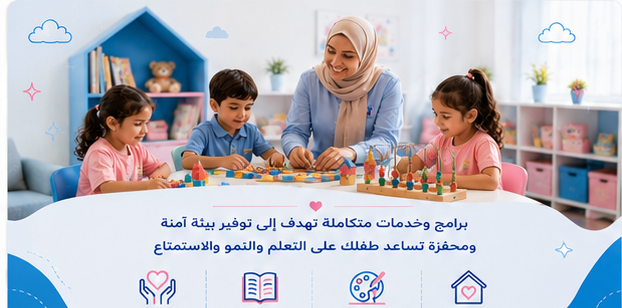
Some mothers think nursery is only about looking after a child while their parents are busy, but a good nursery can be an important environment that helps a child learn, build skills and shape their character through play, activities and interaction with other children.
In their first years a child learns continuously through experience, observation and participation, which is why a nursery provides a structured environment that helps them develop their skills in a way suited to their age and abilities.
What does a child learn at nursery?
1. Social skills and getting along with others
One of the most important skills a child begins to acquire at nursery is the ability to get along with others. Through group play and shared activities, a child gradually learns:
- Sharing toys and equipment with others.
- Waiting their turn.
- Cooperating with their classmates.
- Expressing their needs and feelings.
- Listening to others.
- Forming relationships and friendships.
- Handling the different situations of daily life.
These experiences help a child become far more able to interact with the people around them.
2. Self-reliance
Nursery is a good opportunity to encourage a child to do some things for themselves, in line with their age and abilities. A child may gradually learn to:
- Tidy their toys away when they have finished.
- Choose the activity they want to join in.
- Eat and drink more independently.
- Put on some of their clothes or shoes with a little help.
- Look after their own belongings.
The aim is not for a child to do everything alone, but to give them the chance to try and to build confidence in what they can do.
3. Language and communication
Constant communication with the teachers and the other children enriches a child's language and strengthens their ability to express themselves. Through stories, songs, conversation and daily activities, a child encounters new words and ideas that help them:
- Build their vocabulary.
- Express what they want and need.
- Listen to and understand simple instructions.
- Speak and interact with others.
- Describe the things and events around them.
4. Learning through play
Play is not just entertainment; it is one of the most important ways a child learns in the early years. When a child builds with blocks, fits shapes together, or joins in a group game, they are developing a whole set of skills in an enjoyable, natural way. Play helps develop:
- Thinking and problem solving.
- Focus and attention.
- Imagination and creativity.
- Motor skills.
- Communication and cooperation skills.
5. Developing motor skills
Age-appropriate activities help develop a child's gross and fine motor skills. Gross motor skills such as running, jumping, balancing and moving about during play.
Fine motor skills such as drawing, colouring, working with dough, fitting pieces together and craft activities. These skills help a child carry out many everyday tasks with far more independence.
6. Learning colours, shapes and numbers
Nursery begins introducing basic educational concepts in a simple, enjoyable way suited to a child's age. Through activities and games a child may come to know:
- Colours.
- Shapes.
- Numbers.
- Sizes.
- Sorting and comparing.
- Some spatial concepts such as above, below, inside and outside.
Most important of all is that a child learns these ideas through experience and play, not through memorising alone.
7. Expressing feelings
A child needs to learn how to understand their feelings and express them appropriately.
Through the teachers' interaction with the children and the situations of daily life, a child can be helped to recognise feelings such as joy, sadness, anger and fear, and to express them in words rather than relying only on crying or unsuitable behaviour.
8. Keeping to a routine and simple rules
A clear daily routine helps a child understand what will happen during their day.
Once a child is used to times for play, activities, rest and tidying up, they gradually begin to understand the idea of a routine and to follow simple instructions.
They also learn that there are shared rules that help everyone play and learn in a structured, safe environment.
9. Building creativity and imagination
Artistic activities, stories and imaginative play give a child room to express their ideas in their own way. For example:
- Drawing and colouring.
- Craft work.
- Stories.
- Acting and imaginative play.
- Music and movement activities.
The aim is not always a perfect result, but giving a child the chance to try, to express themselves and to create.
10. Getting ready for the next stage of education
A nursery is not a miniature school, but it does help a child acquire a set of skills that can make them far readier for the move to the educational stages that follow. A child gradually gets used to:
- Listening to the teacher.
- Joining in activities.
- Sitting for a period suited to the activity.
- Following simple instructions.
- Being part of a group of children.
- Relying on themselves for some tasks.
These skills form an important foundation for their future learning.
Is nursery only about learning?
When a mother is looking for the right nursery for her child, the question should not only be: what will my child learn? It is also worth asking:
Will my child feel safe? Will they enjoy their time? Will they have the chance to play and interact? And is their development properly followed?
A child at nursery age needs an environment that brings together care, play, learning and social interaction, with regard for their age, their character and their individual needs.
What does Kids Castle offer children?
At Kids Castle we work to make a child's experience full of learning and discovery through educational and enrichment activities, interaction with other children, and the building of their social, motor and language skills, in a safe environment suited to the early years.
The aim is not only for a child to learn information, but for them to enjoy learning, gain self-confidence, and develop step by step.
If you are looking for a children's nursery in Riyadh that gives your child an environment combining learning, play and interaction, explore Kids Castle's programmes and choose what suits your child's age and needs.