When a child reaches the early years, some mothers find themselves facing an important question: is nursery better for my child, or is home care the more suitable choice?
There is no single answer that suits every child and every family. Choosing between nursery and home care depends on a child's age, their character, their needs, and the family's circumstances.
But understanding the differences between the two helps a mother make a clearer decision and choose the environment that gives her child the best possible experience.
What is meant by home care?
Home care means a child stays at home with one of their parents or with a carer, receiving their daily care within familiar surroundings.
Among its chief advantages is that the child stays somewhere familiar to them, may get more one-to-one attention, and can follow a more flexible daily routine.
On the other hand, the chances for regular interaction with other children and for joining in group activities may be limited, depending on the nature of the care available at home.
What is meant by nursery?
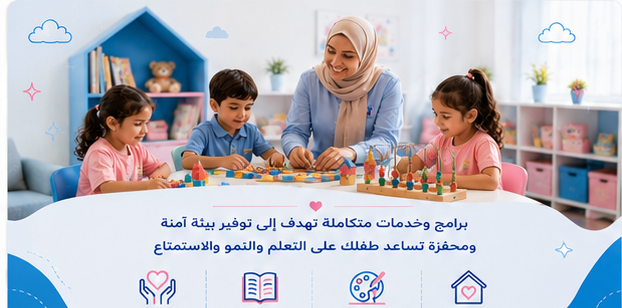
A nursery is an environment dedicated to caring for children in the early years, and it usually offers a daily programme combining care, play, educational and enrichment activities, and social interaction
At nursery a child learns through experience, participation and interaction with the teachers and the other children, within a daily routine that helps them acquire a set of age-appropriate skills.
The main differences between nursery and home care
1. Social interaction
One of the clearest differences is that nursery gives a child a daily opportunity to interact with a group of other children. Through play and group activities, a child learns:
- Sharing.
- Waiting their turn.
- Cooperation.
- Communicating with others.
- Forming social relationships.
- Handling different situations.
With home care, social interaction may be less frequent, unless the family makes a point of arranging get-togethers and activities for their child with other children.
2. Learning and activities
At nursery, a set of activities suited to a child's age is organised, such as:
- Stories.
- Drawing and colouring.
- Physical activities.
- Educational games.
- Artistic activities.
- Group play.
- Learning colours, shapes and numbers.
At home, the level of educational activity depends on the time, experience and materials the family or carer has available. This is not a matter of one option always being better, but of how good the environment and activities a child actually gets are.
3. Self-reliance
Being among a group of children in a structured environment helps a child try some things for themselves. They may gradually begin to:
- Tidy their toys.
- Look after their belongings.
- Follow simple instructions.
- Choose some of their activities.
- Try doing everyday tasks themselves.
Home care, meanwhile, may be more accommodating in helping a child meet their daily needs.
4. The daily routine
Children need a clear routine that helps them know what will happen during their day. A nursery usually provides a daily schedule with times for activities, play, rest and other periods suited to a child's age.
At home, a family can design a routine that suits their child, and it may be more flexible than a nursery's schedule.
5. The social environment
At home, a child may spend most of their time with family members or a carer.
At nursery, a child is exposed far more to a variety of social situations, and learns how to deal with different people outside the family circle. These daily experiences can help them develop communication, cooperation and adaptability.
6. Getting ready for the next stage of education
Going to nursery does not mean a child should be learning school curricula early. But a structured environment does help a child acquire important skills before moving on to the educational stages that follow, such as:
- Listening.
- Following instructions.
- Joining in.
- Concentrating for a reasonable period.
- Being part of a group of children.
- Self-reliance.
These skills can also be developed at home, particularly when the family provides suitable activities and a suitable routine for their child.
Is nursery better than home care?
Neither option is necessarily better for every child.
Nursery may suit better when a family needs a structured environment that gives their child care, activities and social interaction day by day.
Home care may suit some children and families who prefer a quieter, more flexible home environment, or where a child needs more one-to-one care.
So it is better for the question not to be: "Which is better in general?"
But rather:
"Which environment better suits my child and my family's needs?"
How do you choose the right option for your child?
- Does my child enjoy interacting with other children?
- Do they need a structured environment and a daily routine?
- Do they need more interaction and activity?
- Does home care give them varied activities?
- Does the carer have the capacity and the time to engage with my child?
- Is the nursery I am considering suitable for my child's age?
- Is the environment safe, clean and suited to children?
- Can I visit the nursery and see how the teachers work with the children?
Answering these questions will help you identify the option closest to your child's needs.
What should you look for when choosing a nursery?
If you decide nursery is the right choice for your child, don't settle for asking about price or opening hours.
Pay attention also to:
Safety:
Is the environment suited to children? And are there clear procedures for safety and for drop-off and collection?
The teachers:
How do the teachers work with the children? And is there attention to each child's needs?
The activities:
Does the centre offer varied activities suited to the children's ages?
Cleanliness and organisation:
Are the classrooms, bathrooms and play areas clean and well organised?
Communication with the family:
Can a mother find out how her child is, and follow their day and their development?
Flexible attendance:
Are there options to suit the family's circumstances, such as full day, part day or day-by-day attendance?
Nursery and home care can complement each other
Choosing nursery does not mean the home's part is over. On the contrary, the best experience for a child comes when there is a partnership and open communication between family and nursery.
A child can learn at nursery through play, interaction and activities, and then continue developing those skills at home through conversation, reading, play and joining in everyday tasks.
At Kids Castle
At Kids Castle we believe the early years are not simply a time for care, but an important stage for discovering what a child is capable of and building their skills and character.
That is why we work to provide an environment that brings together care, play, learning, activities and social interaction, in line with each child's age and needs.
And if you are unsure whether nursery is right for your child, trying it for a short period before committing to a longer plan can help you see how comfortable your child is in the new environment.
In summary
Nursery and home care each have their advantages, and the better choice depends on the child's and the family's needs and on the quality of the environment available.
If a nursery gives your child safety, care, suitable activities, social interaction and individual attention, it can be a valuable and enjoyable experience that helps them develop their skills and get ready for the stages ahead.
Home care, meanwhile, may be the right choice where a good home environment gives a child the attention, activities and interaction they need. What matters most is choosing the environment in which your child feels safe and comfortable, and in which they get real opportunities to play, learn and develop.
Frequently asked questions
Is nursery better than home care?
There is no option that is better for every child. The choice depends on a child's age, character and needs, as well as on the quality of the nursery or the standard of care available at home.
Does nursery help a child develop social skills?
Yes. Daily interaction with other children and with the teachers gives a child the chance to learn through sharing, cooperating, communicating and playing in a group.
Can a child learn at home?
Yes. A child can acquire a great many skills at home through play, reading, conversation and everyday activities, but a nursery provides a structured social environment and group experiences that can be hard to replicate at home.
Do I have to register my child for the full day?
Not necessarily. It depends on the family's and the child's needs, and part-day or day-by-day programmes may suit some children and families.
Can I try the nursery before committing to a monthly plan?
Options differ from one nursery to another, so it is worth asking whether you can try the nursery for a short period before signing up for longer, particularly if it is your child's first experience of nursery.