Many parents find it hard to decide how best to care for their child in the first years: should the child stay at home with the family or with a carer, or would they benefit from an educational nursery? Home care gives a child comfort and one-to-one attention, and it is the right choice for some families, but an educational nursery offers a different experience, one that combines care, learning, social interaction and age-appropriate activities.
What is the difference between an educational nursery and home care?
Home care focuses primarily on safety and on meeting a child's daily needs, while an educational nursery provides a structured environment prepared for a child's growth and for developing their skills through a varied daily programme. That does not mean either option suits every child: a child's needs and a family's circumstances differ from one case to the next. But an educational nursery can offer some advantages that are hard to provide consistently at home.
The main advantages of an educational nursery
1. Learning through play and activities
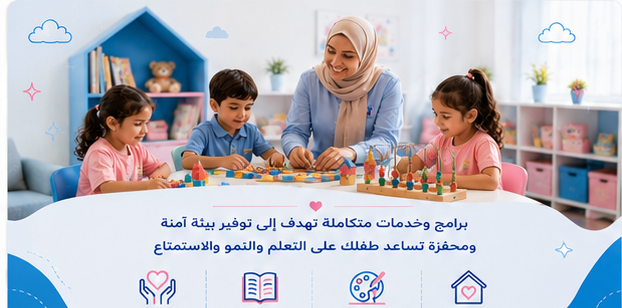
A nursery offers activities designed to suit a child's age, such as drawing and colouring, stories, educational games, and sensory and physical activities. These activities help a child learn and acquire skills in an enjoyable, natural way.
2. Building social skills
One of the chief advantages of nursery is that a child spends time with other children every day, which gives them the chance to make new friends and to learn through interacting with them.
Through these experiences a child gradually learns:
- Sharing.
- Cooperation.
- Waiting their turn.
- Expressing their needs.
- Respect for others.
- Handling different situations.
3. Building independence and self-confidence
At nursery a child gets the chance to do some things for themselves — tidying their toys, choosing their activity, joining in group activities and completing simple tasks. These experiences help them rely on themselves and build confidence in what they can do.
4. A structured daily routine
A structured routine helps a child know what will happen during their day: activity time, play, meals and rest. A routine suited to a child's age can help them build daily habits and feel more settled.
5. An environment designed for children
What marks out an educational nursery is an environment, equipment and activities designed to suit children's needs and ages. This gives a child room to move, play, explore and learn in surroundings built for exactly that.
6. Discovering a child's skills and interests
By watching a child during the daily activities, teachers can notice their interests, their strengths, and the skills that need support. A child may show an interest in drawing, in building, in movement, in stories or in socialising, and a learning environment helps bring these out early.
Does nursery replace the family's role?
Certainly not. The family is the first and most important environment in a child's life. A nursery does not take the family's place; it complements it. The best experience for a child comes when family and nursery work together, each sharing what they observe about the child's development and needs.
When is an educational nursery the right choice?
A nursery may be the right choice for families looking for an environment that combines care with learning, particularly when both parents are busy at work or want to give their child a social and educational experience.
When choosing a nursery it is important to make sure it offers a safe environment, a programme suited to your child's age, varied activities, and a qualified team concerned with your child's development and not only their care. Kids Castle — care and learning in one place
At Kids Castle we believe a child needs more than day-to-day care.
That is why we work to provide an environment that brings together care, learning, play and social interaction, through activities and programmes suited to children's ages and needs.
We want every child to feel safe and happy, and at the same time to have daily opportunities to learn, explore, develop their skills and build their character.
At Kids Castle, we believe a nursery is not just somewhere a child is looked after, but an environment that helps them grow, learn and discover what they are capable of.